
Inclusive practice in Te Whāriki: A reflection for teachers to implement
Practitioner Research: Vol 8, No 3 - December 2025
As a heart-led kaiako, I view all children the same: as unique individuals. I believe it is the role of the kaiako to support and guide them to achieve at their own pace, regardless of ability, strength, or needs. It takes patience and a willingness to really get to know tamariki as their unique selves and adapt teaching strategies to provide appropriate support to achieve, as well as affirming children as capable and competent. As with any intentional learning plan, collaborating with whānau is even more essential when working with tamariki with disabilities. In this article, I examine Te Whāriki (Ministry of Education [MoE], 2017), New Zealand’s early childhood curriculum, as the guide for supporting a strengths-based perspective to teaching. I will provide examples of how to foster and create a quality environment of belonging, participation, and equitable learning opportunities for all children with a range of abilities and needs. This examination and examples can demonstrate how inclusive pedagogy is achievable.
Introduction
Te Whāriki (MoE, 2017) positions children as confident and competent learners from birth. As kaiako, we are encouraged to view tamariki this way and to support their learning and development through approaches that are appropriate and relevant to their interests, strengths and abilities. The Teaching standard in Our Code, Our Standards (Education Council, 2017), guides kaiako to “teach in ways that ensure all learners are making sufficient progress, and monitor the extent and pace of learning, focusing on equity and excellence for all” (p. 20). The Education Review Office [ERO] (2022) identified in their report, A great start? Education for disabled children in early childhood education: examples of good practice for leaders and kaiako, four key areas of effective inclusive pedagogy for kaiako that make a significant difference for learners with disabilities; effective leadership and strong expectations for inclusion; quality teaching; inclusive, accessible environments; and strong, learning-focused partnerships with parents and whānau. The examples in this article will provide support for implementing these key areas.
An inclusive curriculum
Te Whāriki (MoE, 2017) is a curriculum for all children, including those with diversity of ability and learning needs. The curriculum “requires kaiako to actively respond to the strengths, interests, abilities, and needs of each child and, at times, provide them with additional support in relation to learning, behaviour, and development of communication” (MoE, 2017, p. 13). This requirement aligns with the distinction in education: equality is not equity. Treating tamariki the same is equality. Supporting tamariki by responding and adapting to their individual strengths, interests, abilities, and needs is equity. This means that when kaiako plan and implement learning for tamariki, we provide them with opportunities to achieve that are specific to their needs, abilities and strengths, making necessary changes to strategies or learning opportunities that may be different to what is provided for another tamaiti. For example, holding their hand so they can walk across the plank, or providing a spoon instead of a fork to feed themselves, or adding a step ladder so they can reach the bag hook.
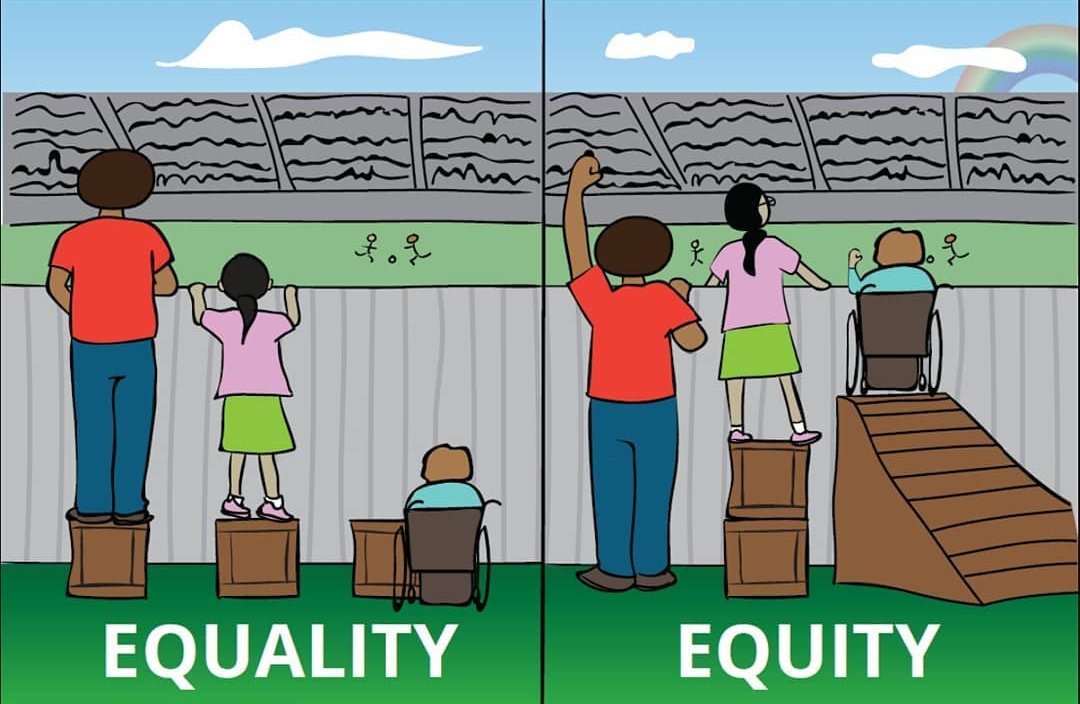 Image1:
 As shown in the image, the support and guidance required for every individual child are different, and it is our job as kaiako to ensure we understand what they need to achieve and reach their goals. I view this as responsive equity: removing barriers and adapting environments (Conn, 2022) and teaching strategies.
According to Te Whāriki (MoE, 2017), “offering an inclusive curriculum involves adapting environments and teaching approaches as necessary and removing any barriers to participation and learning” (p. 13). These barriers may be physical, social, or conceptual (beliefs of others). The following examples illustrate how such barriers can be minimised.
Partnering with whānau
We learn what tamariki may need through our observation of their interactions with the classroom materials and through our engagement with them. It is essential to also engage in professional learning kōrero with whānau. ERO (2022) indicate that kaiako should work with whānau to understand how to best support their tamariki to be fully included in learning and play. We know that parents and whānau are the first teacher of tamariki and know their child best. The Family and Community Principle in Te Whāriki specifically asserts “teaching inclusively means that kaiako will work together with families, whānau and community to identify and dismantle … barriers.” (MoE, 2017, p. 13). As well as partnering with whānau, this may mean that there is a need to seek additional support and resources from appropriate agencies to be able to provide access for tamariki, or for support with teaching practice. Teaching should still be done while waiting for additional support.
For kaiako, engaging in collaborative relationships with whānau to support their tamariki means being active in discussing and willing to listen to their aspirations for learning, as well as learning what the tamariki need in order to learn. Inviting whānau to share the interests and strengths of their child, as well as their struggles can develop a professional relationship focused on creating a learning environment that is tailored to the needs and learning for this tamaiti. Whānau of tamariki with disabilities want to be engaged in learning conversations about the learning of their tamaiti, as any parents do. If whānau are only approached to be told about the behaviour of their tamaiti, and not their learning and achievements, their willingness to engage in learning kōrero will be lost. Be brave and ask what they struggle with at home, or what they want their tamaiti to learn, and problem-solve together to weave this through the learning plan. There may be discussions about how to support tamariki to sleep at night, or to eat vegetables, or about the parent being exhausted. With our education in child development theories, connections with other kaiako and colleagues, continuous reflective practice, and practical experience, we can work together to support achievement for all tamariki and their whānau. Offering ideas to support with sleeping or sharing what kai is eaten at the centre could support the struggles at home. Being an empathetic and listening ear to whānau can go a long way to support them to feel heard and a sense of belonging and safety for both them and their tamaiti at your centre. Having these wellbeing conversations builds trust in the relationship and will open up a pathway for discussion about learning aspirations.
Access and Participation
When we plan learning for tamariki, we need to ensure that all tamariki can both access and engage with the learning materials, together and individually. For infants, we (should) ensure materials are within reach, so for tamariki with a disability, physical, cognitive, or other, we need to make sure they too can reach and access materials by themselves. You and your centre may need to reflect on whether a tamaiti in a wheelchair can access the bathroom or playground independently and then put plans in place to remedy this. This is more formal access situation. In the classroom, our actions and language enable or disable children’s abilities to participate.
Learning experiences should be designed in ways that they can be adapted and flexible to each individual, with an appropriate range of materials for increasing difficulty and exploration for everyone. For example, in a mixed-age setting, younger tamariki want to participate in the interesting art activity planned for the older tamariki, so having resources available for their own exploration alongside the older tamariki is provided. This can also be done for tamariki with a disability or different ability, meaning that resources may need to be on a tray to fit on their knee in the wheelchair. Or, for a tamaiti who wants to paint and move constantly, the painting activity could be adapted so that the paint is about one metre away from the table or easel, enabling the movement to occur between the two for this tamaiti to participate in their own way. Understanding tamariki urges and fascinations can go a long way to support kaiako to provide an enabling learning environment to suit the diversity of needs and interests of all tamariki. Other patterns of behaviour, or urges, may also signal opportunities for adapting the environment. Observing resources frequently being swept onto the floor from the table as the tamaiti explores gravity or the sounds items make when they fall, could indicate some creative thinking on behalf of the kaiako to cater for the different ways of exploring and learning. Having a basket or set of resources for this exploration, or providing a basket or vessel to catch items, or using intentional language may be options. Commenting on the action and the resulting sound they made when these items hit the ground, or asking tamariki what else makes that sound can support all tamariki to be curious about the ways others learn and explore. Being curious and open to this learning approach yourself, rather than being annoyed with having to remind the child not to swipe items off the table will enable this inclusiveness.
The key here is to ensure that our mindset is open to the belief that all tamariki can achieve, in their own time, and at their own pace. Te Whāriki describes in their own time and at their own pace, as “ā tonā wā” (MoE, 2017, p. 13). We must be active to support this. Learning to use sign language, for example, will enable kaiako to support deaf or hard of hearing tamariki, as would learning about sensory overload support kaiako to gain ideas on how to support tamariki with sensory processing difficulties. It is a responsibility of kaiako to be “knowledgeable about children’s learning and development and able to identify their varied abilities, strengths, interests and learning trajectories” (MoE, 2017, p. 59). If kaiako feel they are not knowledgeable in being able to support individuals, then Our Code, Our Standards (Education Council, 2017)guides kaiako to seek this knowledge through ongoing learning. Saying that you do not know how to support a child with Autism creates a barrier that declares kaiako do not wish to, or that it is too hard. Our curriculum includes all tamariki and requires kaiako to create enabling environments, including our ability to teach and learn alongside tamariki. This means modelling and inspiring inclusive behaviours and attitudes and have high expectations for all children’s learning by engaging in our own inquiry to learn what is necessary. This can be achieved through engaging in kōrero with colleagues, researching academic literature, or attending formal professional development courses to further confidence to support all tamariki.
Learning with and alongside others
During my experience as a teacher as well as a visiting lecturer, I have often noted tamariki with additional needs being left to their own devices. These tamariki are labelled as having Autism or by a certain behaviour. Kaiako justify leaving them alone to do their own thing as this appears to make the tamaiti happier. This is a demonstration of supporting tamariki with additional needs to have access to the ECE environment, but is not necessarily encouraging engagement or participation. Conn (2022) says that reducing children to a criteria or label is problematic and it leads to assumptions of abilities and negates individual personalities. Te Whāriki’s ‘Responsibilities of Kaiako’ includes being “inclusive, enabling all children to learn with and alongside their peers” (MoE, 2017, p. 59).
Here is an example of how to support peer learning. If you have a tamaiti (let’s call her Alice) who is easily overwhelmed with a large group of tamariki, or doesn’t like to engage directly with others, but loves to build with blocks, you could model playing alongside them. You might sit quietly on the same mat and build too. You might move a larger, smaller or different shaped block closer if you notice Alice is having difficulty with balancing a tower. You may provide descriptive commentary (MoE, 2020) on what you are doing to your own tower to explain how you are making it stop falling over. Another tamaiti may come to build with you, and you invite them to sit and join in, and continue to comment on your actions together. Here is a great opportunity to support social noticing (MoE, 2019) and describe to this tamaiti what Alice is doing and how they have solved the problem. You might invite this tamaiti to offer Alice another block. This is demonstrating to tamariki that even though Alice learns differently, they are still part of the group, and you are actively including them and encouraging other tamariki to notice and include them also. This is also modelling to Alice that they are part of this group, and their contributions and learning are noticed, appreciated, and affirmed. Leaving tamariki alone is not always the best solution for supporting their access and participation in the ECE setting.
ERO (2022) noted that tamariki with disabilities benefit when kaiako actively ensure opportunities and space are provided for positive peer relationships to be formed and nurtured, by promoting collaborative learning. It is important to ensure this is done sensitively with the knowledge you have of individual learning preferences, needs and strengths.
Rights of children with disabilities
Te Whāriki (MoE, 2017) acknowledges that “all children have rights to protection and promotion of their health and wellbeing, to equitable access to learning opportunities, to recognition of their language, culture and identity, and, increasingly, to agency in their own lives” (p. 12). Article 23 of the United Nations Convention on the Rights of the Child states that a mentally or physically disabled child had rights to an environment that promotes self-reliance and participation in the community and receives education to achieve to their fullest possible social integration and individual development (United Nations, 1989).
Recognising and responding to the rights of children with disabilities has long been central to progressive educational approaches. Maria Montessori, for instance, started her teaching journey after earlier experiences as a physician working with “abnormal” children (Cossentino, 2006). She observed tamariki with cognitive disabilities, noting they needed suitable education rather than medical treatment (Isaacs, 2018). In the early 1900s, her observations led to the design and manufacturing of teaching materials to sharpen the senses and teach skills of everyday life, to support sensory engagement and a feeling of mastery (Cossentino, 2006). Dr Montessori’s observations noted that through developing practical life skills and choosing their own work, tamariki develop confidence and achievement in their own time, revealing their true potential (Isaacs, 2018). Therefore, it could be a good place to start with supporting tamariki to have agency in their own lives, by believing in them and nurturing them to achieve mastery of skills that support independence, such as providing opportunities for putting on their own clothing, getting themselves a drink of water, or being able to choose materials and people to play and learn with. The Contribution strand in Te Whāriki (MoE, 2017) encourages kaiako to support tamariki to contribute their own strengths and interests to their learning. The goal of providing equitable opportunities for learning, irrespective of gender, ability, age, ethnicity or background (MoE, 2017) specifically includes provision for children with disabilities or additional learning needs. Kaiako should be focused on what tamariki are interested in, how they engage, and what they are drawn to (Conn, 2022). When we know this about tamariki, learning is enabled. When we provide an enabling environment for tamariki to develop and learn through their strengths, interests and abilities, they will be able to recognise and appreciate their own ability to learn as they communicate their needs, play an active part in the learning environment and in their own learning (MoE, 2017).
Tamariki are taonga
Within te ao Māori, language provides powerful ways to understand and affirm the uniqueness of tamariki. The term ‘takiwātanga’ is used to describe tamariki with Autism. This term is a mana-enhancing term rather than a deficit term, meaning “in your own time and space” (MoE, 2023). This encourages us to see each and every tamaiti, regardless of ability, as a taonga (treasure) and acknowledge and support their development in their own time and pace. This also encourages us to think about how our language and labelling may uplift or deflate mana.
Pause and reflect for a moment on these questions:
- Do I like to be seen and heard? To have my interests acknowledged and my needs met?
- How do I want my opinion to be sought? To feel valued for my contribution?
- How do I like to feel included, loved, and participate with my peers?
- Do I want opportunities to do things for myself?
Armed with these inner thoughts, you can support all tamariki to feel the same.
Te Whāriki (MoE, 2017) has some questions for reflection that can help reflection with colleagues, and how to create an inclusive curriculum for all tamariki in your setting. Here are two of them that could be used right now to get this process started:
- How effectively does the curriculum provide for the interests, strengths, abilities, and preferences of all children and support them in building positive learner identities? (p. 40).
- How do kaiako empower all children to pursue challenges in ways that acknowledge their current physical and cognitive abilities and strengths? (p. 50).
Inclusion does not have to be complicated: it is achievable through intentional, active pedagogy. As you do for any child, for tamariki with disabilities or additional learning needs, protect their dignity and build, affirm, and enhance their mana through intentional inclusive pedagogy and active participation. Te Whāriki (MoE, 2017) is an inclusive curriculum and Our Code, Our Standards (Education Council, 2017) and ERO (2022) guidance, have been examined to highlight how kaiako can create enabling, equitable learning environments for all tamariki. Collaborating with whānau, encouraging participation with and alongside peers in an enabling environment, ensuring we view tamariki from a strengths-based perspective, and value and affirm each child as a unique individual are some of the ways to support and guide inclusive pedagogy. Engage further with teaching teams and whānau and reflect on ways pedagogy can be enhanced to ensure enabling environments and equitable opportunities are provided for all tamariki regardless of abilities and needs.
References
- Conn, C. (2022). Seeing children’s learning subjectivities for inclusive pedagogy in early childhood education. In C. Conn & A. Murphy (Eds.), Inclusive pedagogies for early childhood education (pp. 43-58). Routledge.
- Cossentino, J. (2006). Big work: Goodness, vocation, and engagement in the Montessori method. Curriculum Inquiry, 36(1), 63–92.
- Education Council. (2017). Our code, our standards: Code of professional responsibility and standards for the teaching profession.
- Education Review Office. (2022). A great start? Education for disabled children in early childhood education: Examples of good practice for leaders and kaiako. https://www.ero.govt.nz
- Isaacs, B. (2018). Understanding the Montessori Approach (2nd ed.). Routledge.
- Ministry of Education. (2017). Te Whāriki. He Whāriki mātauranga mō ngā mokopuna o Aotearoa: Early childhood curriculum.
- Ministry of Education. (2019). He Māpuna te tamaiti. Supporting social and emotional competence in early learning.
- Ministry of Education. (2020). Talking together. Te kōreroreo.
- Ministry of Education. (2023). Takiwātanga – in your own time and space. Education Gazette, 102(1). https://gazette.education.govt.nz/articles/takiwatanga-in-your-own-time-and-space/
- United Nations. (1989). Convention on the rights of the child. United Nations Human Rights Office of the High Commissioner. https://www.ohchr.org/en/instruments-mechanisms/instruments/convention-rights-child
How to cite this article
Hearfield, K. (2025). Inclusive practice in Te Whāriki: A reflection for teachers to implement. He Kupu, 8(3), 9-14.
