
“It’s me” – Exploring the image as a powerful enabler of the child’s voice
Practitioner Research: Vol 8, No 3 - December 2025
The image is a powerful tool in nurturing a child’s identity as a capable and confident learner, as upheld in the New Zealand early childhood curriculum (Ministry of Education, [MoE], 2017). Guided by this vision of the child, teachers work to make valued learning visible through formative assessment practices intended to support ongoing learning. With the high uptake of digital communications used in formative assessment there is room to explore how images of the child might influence inclusion of the child’s views in assessment. In this article I examine the concept of the image, defined as a photo taken of the child for pedagogical purposes, and discuss ways the image may enable the child’s voice in their learning. The potential tensions involved in the utility of the image are explored. Lastly, I reflect on my ongoing learning as an infant toddler teacher sharing examples of experiences using the image to elicit the child’s voice in their learning and development.
Digitised communication and the increasing use of the image
In early childhood education [ECE] there has been a significant increase in digital communications including the use of images (Hopkins, 2023; Perkins, 2017). An image is described by Engels-Schwarzpaul (2021) as recording a past experience, something evoking emotional responses and holding aliveness. The image as being ‘alive’ is relevant to ECE as for a young child an image offers greater connection and meaning than written text. Furthermore, teachers use images to capture, understand, and extend learning (Cameron, 2023; Gunn et al., 2022). In taking and sharing images it is important to think critically about the power of the image as it does not stand alone but is framed by the context, people involved, and intended recipients (Kjeldsen, 2021). Consequently, in ECE the image, which has grown to be an accepted component in making learning visible as outlined in Te Whāriki: He Whāriki Mātauranga mō ngā Mokopuna o Aotearoa (MoE, 2017), needs to be examined and understood.
Making learning visible is central to formative assessment described by Drummond (2012), as the everyday practice where “we observe children’s learning, strive to understand it, and then put our understanding to good use” (p. vii). Assessment that is formative acknowledges children’s existing skills and understandings, including learning about children’s wider contexts and experiences to progress learning (MoE, 2017). In formative assessment the exchange of images, when interpreted in collaboration with the child and whānau, can support shared understandings (Pennells, 2021; Whyte, 2016). For example, an image can invite dialogue with the child about a particular event, thus enabling the child’s perspective to be included in planned next steps in learning (Harris, 2023). However, thought must be afforded to how the utility of the image is influenced by potential power imbalances.
Whilst the role of the image can be argued as benefitting making learning visible consideration of the power difference between the photographed child and the photographer should be acknowledged (Hopkins, 2023; Lindgren, 2012). Te Whāriki (MoE, 2017)advocates for the empowerment of the child as an active participant in their learning, however, the pedagogical shift to technology and increasing ability to photograph may unintentionally compromise the child’s agency in contributing their ideas (Cameron, 2023). Research highlights the potential challenges to the inclusion of the child’s voice in pedagogical documentation which is largely online with most communications occurring between teacher and parent (Higgins & Cherrington, 2017; Hooker, 2017). Theobald (2019) suggests “Pedagogical approaches do not always attend to children’s views and opportunities for participation, especially in the case of very young children” (p. 253). This brings into question how teachers, who hold the knowledge and position with technology, might navigate opportunities for the child’s voice, including their agency in accessing and responding to the image.
Children’s voices and the image – Do you hear me?
The United Nations Convention on the Rights of the Child (United Nations, 1989), in particular Articles 12 and 13, and Te Whāriki (MoE, 2017) emphasise the acknowledgement and value of the child’s voice and perspective. Promoting children’s voices is viewed as a measure of quality in ECE therefore teachers must consider practices that invite children’s contributions and actively listen to their voices to understand their needs and interests (Harris, 2023; MoE, 2017). A suitable definition of the child’s voice which acknowledges their contribution in ECE is “…views of children that are actively received and acknowledged as valuable contributors to decision-making affecting the children’s lives” (Murray, 2019, p. 1). However, Theobald (2019) highlights the voice of the child can be compromised by the knowledge, expertise, and position of adults This dilemma is real for teachers who make decisions daily about what images are taken and how, and with whom, they are shared (Kervin et al., 2023; McLachlan & McLaughlin, 2023). Consequently, teachers need to be mindful of how they promote inclusion of the child’s voice through enabling the child to access images taken.
Given the image can be read by a child more easily than written text accessibility is key. Kei tua o te pae. Assessment for learning: Early childhood exemplars (MoE, 2004) affirms feedback through documentation includes “photographs that children can read themselves” (p. 6). Tong (2023) proposes accessibility to images encourages children’s active agentic participation as upheld by Te Whāriki (MoE, 2017) and includes involvement with the people, places and things important to them. As such older children can be involved in taking photographs, discussing their thoughts and revisiting learning stories, a narrative of valued learning (Carr & Lee, 2019; Gunn et al., 2022). Additionally, Reese et al. (2019) describe how, when teachers invite the child’s account of events in photos, ongoing learning is positively informed. However, infants’ and toddlers’ interests are more likely to be in viewing photographs thus challenging teachers to have images in easy reach (Hopkins, 2023) and being watchful and responsive to the child’s reaction to the image (Harris, 2023; Murray, 2019).
Teachers play a crucial role in advocating for the child’s voice through being attentive to children’s efforts to communicate (Murray, 2019; Tong, 2023). The image is a tool for interpretation and understanding offering an effective cue for inviting feedback on previous experiences (Kjeldsen, 2021; Parnell & Bartlett, 2012). For example, in viewing an image of themselves a child may respond with either verbal or non-verbal cues. Body language or gestures can act as a prompt, an invitation to engage in ongoing reciprocal exchanges which can lead to enriched learning. Similarly, actively responding to a pointed finger or prolonged focus on an image may indicate emotional connection for the child, empowering their agency and right to have their thoughts, feelings, and preferences validated (Correia et al., 2023; Harris, 2023). Furthermore, as Jia et al. (2023) suggest, teachers must recognise their view as subjective and reflect on their assumptions about the child’s capabilities to communicate in response to an image, since without the child’s voice we risk contradicting the intentions of Te Whāriki (MoE, 2017).
“It’s me” - Some reflective thoughts on the utility of the image
My journey as an ECE teacher is like many others working to facilitate assessment that empowers the child. My passion is working collaboratively with all involved in a child’s learning journey and I have benefitted from the increased communication opportunities afforded by technology. However, in my assessment practices I sometimes feel uneasy with the dominant position I have using digital devices to take images of very young children. I am also aware of the challenges that I, and the sector face in ensuring children stay at the forefront of digitised communications. As a member of a cohesive team in an infant and toddler environment striving for quality assessment, I offer the following reflective thoughts.
A teachers role involves continually gathering information through observation, interaction, discussion and more formally in documentation including images (McLachlan & McLaughlin, 2023). However, the time to conduct assessment inclusive of multiple voices is limited which can problematise gaining the child’s perspective (Niles, 2016). In my experience working with infants and toddlers, the image, when accessible and shared with the child and their whānau can support collaborative interpretation, understanding, and enrich pathways of learning (Pennells, 2021). For example, a proud “It’s me” was noticed when a child found images of herself in the learning space including her portfolio. Subsequent follow up dialogue with the child’s mother resulted in multiple images from home being made into a personalised book. Access to, and the sharing of these images has further developed her language skills and sense of identity. Moreover, teachers have meaningfully acknowledged and grown her funds of knowledge, particularly her understanding of farm related tasks (Gonzalez et al., 2005).
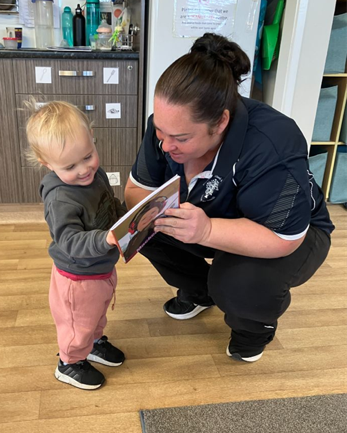
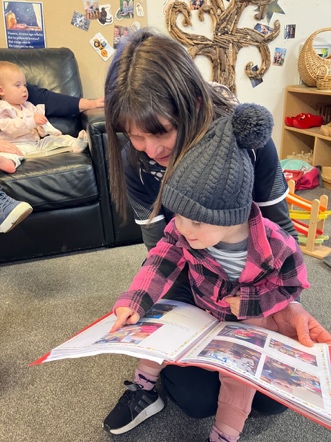
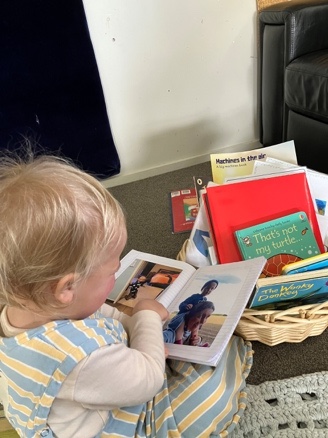
An image can prompt conversations acknowledging “children’s rights to express, or form, a point of view and in so doing assert their rights to be involved in decisions that affect them” (Te One, 2007, p.43).
Enabling the child’s voice through connection with the image is part of the assessment process (Parnell & Bartlett, 2012). When images are accessed by the child teachers need to be attuned and familiar with the individual child’s chosen communication modes and responses. When these communication strategies are observed and meaningfully acknowledged learning pathways are strengthened (MoE, 2004; Murray, 2019). I have found a smile, a pointed finger at an image, a gesture or even focussed silence has prompted my interaction with the child, valuing their active participation in the learning conversation. For example, discussing with whānau a child’s curiosity in images of peers faces on our whānau tree, lockers and interests board I learnt more about the child’s intrigue with facial expressions. Subsequently, my team collaboratively supported sustained interactions with the child nurturing his curiosity, empowering his ability to communicate and be listened to, and positively affirming meaningful connections between home and the centre.
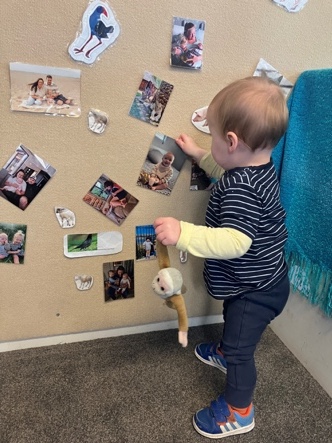
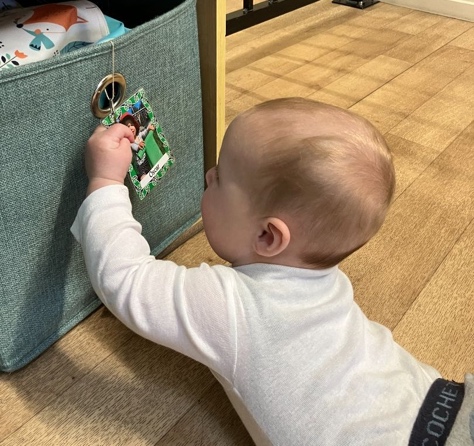
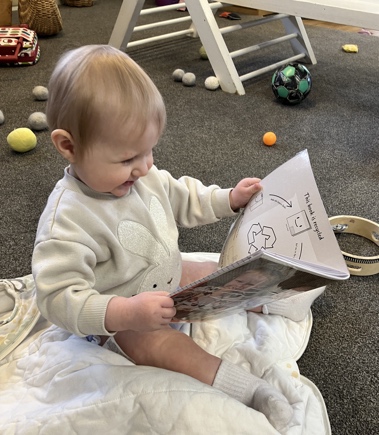
Respect for infants and toddlers diverse forms of communication, including non-verbal cues and gestures, is paramount in recognising the power of the image.
A shared understanding and constant reflection on the intended purpose of the image is crucial in ensuring children’s voices in their learning remain forefront. This involves observation of existing organisational systems and collaborative team discussion to make sure improvements meet the evolving stages and needs of the current children (Kervin et al., 2023). “Consequently, professionals can develop practices tailored to children’s preferences, thus optimising their development and learning” (Correia et al., 2023, p.12). In my experience the regular evaluation of how the image is being utilised to elicit children’s perspectives has led to improved systems such as, relocating our curriculum planning board to where parents, teachers, and children can readily engage with it. The images are large and inclusive of all children.
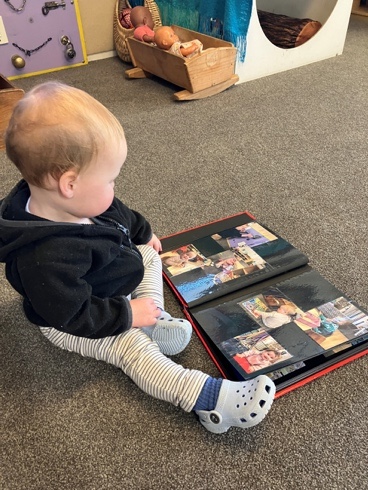
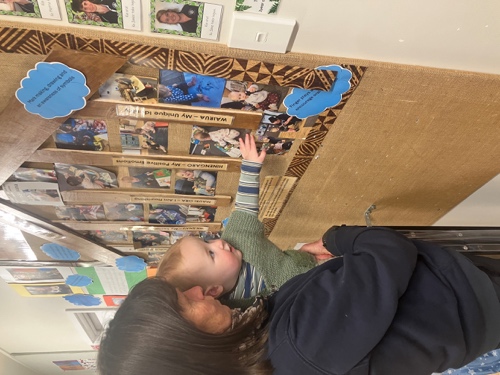
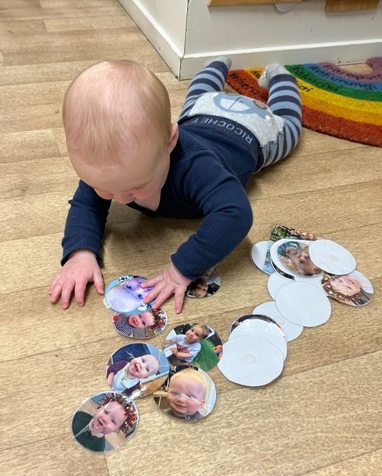
A medley of opportunities to access the image elicits the child’s agency and engagement. “Infants and toddlers often enjoy looking at digital photographs and videos of themselves, family members and peers” (Early Childhood Australia, 2018, p. 5)
Furthermore, our learning space offers multiple options where images, taken by teachers or contributed by parents, are in reach of children. Examples include a low-level whānau tree, personalised images on lockers, individual picture books containing images families have shared, an album of recent images used in learning stories and an interactive photo wall, with moveable images. We are also considering how the location of children’s hardcopy portfolios can offer agency and ownership for older toddlers.
Conclusion
This article has illustrated the potential power of the image in enabling the child’s voice. Despite the improved
communications the advent of technology has brought to ECE, tensions have also arisen regarding inclusion of the
child’s perspective. Findings from research together with my own continued learning suggests we are still unleashing
the full potential of the image. Where there is reflective practice, a shared understanding of the intent of the
image, and a commitment to enabling, and actively listening to the child’s voice the possibilities for improved
learning outcomes are enhanced. I invite teachers to reflect on their commitment to honouring this statement from
Te Whāriki, “Kaiako work to uphold and protect children’s rights, interests, and points of view from
the earliest ages” (MoE, 2017, p.61). Let us think of the image as living, an enabler for the child to tell their
own unique story - “It’s me”!
References
- Cameron, M. (2023). The collection and use of assessment information in early childhood settings. In Assessment and Data Systems in Early Childhood Settings: Theory and Practice (pp. 61-78). Springer Nature Singapore.
- Carr, M., & Lee, W. (2019). Learning stories in practice. Sage.
- Correia, N., Aguiar, C., & Participa Consortium. (2023). Children's voices in early childhood education and care. In Establishing Child Centred Practice in a Changing World, Part B, 9-22.
- Drummond, M. J. (2012). Assessing children's learning (Classic Edition). Routledge.
- Early Childhood Australia. (2018). Statement on young children and digital technologies. http://www.earlychildhoodaustralia.org.au/our-work/submissions-statements/eca-statement-young-children-digital-technologies/.
- Engels-Schwarzpaul, A. C. (2021). Iconicity and appropriation: Images as living things. Educational Philosophy and Theory, 53(7), 683-695.
- González, N., Moll, L. C., & Amanti, C. (Eds.). (2005). Funds of knowledge: Theorizing practices in households, communities, and classrooms. Routledge.
- Gunn, A. C., White, E. J., & Williams, N. (2022). The status of the image in ECE assessment practice: Insights from the field. New Zealand Journal of Teachers' Work, 19(1), 15-28.
- Harris, P. (2023). Child-voiced assessment for understanding children’s learning and transforming pedagogic practices. In Assessment and Data Systems in Early Childhood Settings: Theory and Practice (pp. 243-264). Springer Nature Singapore.
- Higgins, A., & Cherrington, S. (2017). What's the exploring parent–teacher communication through ePortfolios. Australasian Journal of Early Childhood, 42(4), 13-21.
- Hooker, T. (2017). Transforming teachers' formative assessment practices through ePortfolios. Teaching and Teacher Education, 67, 440-453. DOI:10.1016/j.tate.2017.07.004
- Hopkins, D. R. (2023). Relooking at photography use in early childhood education and care in Aotearoa New Zealand. New Zealand Journal of Infant and Toddler Education, 25(1), 27-31.
- Jia, A. C., Cooper, D. M., & Gould, D. K. (2023). Relational ethics-in-action: Learning from naturalistic video observations of infants, toddlers, and their teachers. New Zealand Journal of Infant and Toddler Education, 25(1), 32-36.
- Kervin, L., Bennett, S., & Neilsen-Hewett, C. (2023). E-portfolios to capture and share moments of learning. In Assessment and Data Systems in Early Childhood Settings: Theory and Practice (pp. 105-123). Springer Nature Singapore.
- Kjeldsen, J. E. (2021). Visual rhetoric and the power of imagery: A brief lesson in the rhetorical power of images and the need for phronesis and krisis in the teaching of visual rhetoric: Visuality design in and for education. Video Journal of Education and Pedagogy, 6(1), 1-11.
- Lindgren, A. L. (2012). Ethical issues in pedagogical documentation: Representations of children through digital technology. International Journal of Early Childhood, 44(3), 327-340.
- McLachlan, C., & McLaughlin, T. (2023). Revisiting the roles of teachers as assessors of children’s progress: Exploration of assessment practices, trends, and influences over time. In Assessment and data systems in early childhood settings: Theory and practice (pp. 29-59). Springer Nature Singapore.
- Ministry of Education. (2004). Kei tua o te pae, Assessment for learning: Early childhood exemplars. Learning Media
- Ministry of Education. (2017). Te Whāriki: He Whāriki matauranga mō ngā mokopuna o Aotearoa: Early childhood curriculum. https://tewhariki.tki.org.nz/
- Murray, J. (2019). Hearing young children’s voices. International Journal of Early Years Education, 27(1), 1-5.
- Niles, A. (2016). Complexities of assessment: Striving to get it ‘right’ (Masters thesis, The University of Canterbury). https://ir.canterbury.ac.nz/bitstream/handle/10092/12142/Niles%2c%20Anna_Masters%20Thesis.pdf?sequence=1&isAllowed=y
- Parnell, W. A., & Bartlett, J. (2012). iDocument: How smartphones and tablets are changing documentation in preschool and primary classrooms. Young Children, 67(3), 50-59.
- Pennells, J. (2021). Together is best – partnership in assessment in a digital world: Early Education, 67, 33-38.
- Perkins, M. (2017). Cameras in early childhood settings: Preliminary findings from a small-scale study. Early Education, 61, 22-26.
- Reese, E., Gunn, A., Bateman, A., & Carr, M. (2019). Teacher-child talk about learning stories in New Zealand: A strategy for eliciting children’s complex language. Early Years, 41(5), 506-521.
- Te One, S. (2007). Defining rights: Children’s rights in theory and in practice. Freeman, 7-8.
- Theobald, M. (2019). UN Convention on the Rights of the Child: “Where are we at in recognising children’s rights in early childhood, three decades on…?”. International Journal of Early Childhood, 51(3), 251-257.
- Tong, P. (2023). Nurturing agentic children in early childhood education: thinking about children's agency with a childhood studies lens. He Kupu, 7(3).
- United Nations. (1989). Convention on the Rights of the Child.
- Whyte, M. (2016). Working whānau’ perspectives and involvement in their young child’s learning using the initiating parent voice. (Master’s thesis, University of Auckland). https://researchspace.auckland.ac.nz/bitstream/handle/2292/29086 /whole.pdf?sequence=26
How to cite this article
Pennells, J. (2025). “It’s me” – Exploring the image as a powerful enabler of the child’s voice. He Kupu, 8(3), 15-20.
